AI SEO for Shopify
Be a part of the AI search conversation
Rethink search engine optimization to win in the AI era.
Our guarantee
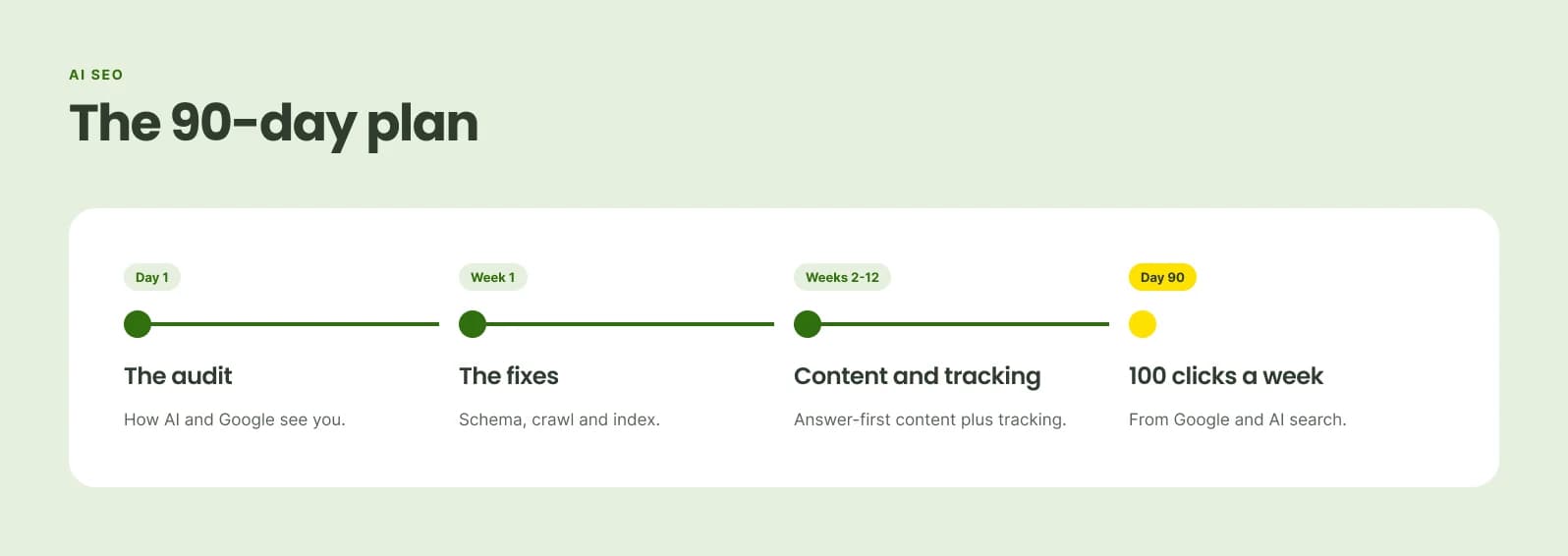
100 clicks a week from Google and AI search by day 90, or you don't pay.
Ninety days of the work below.
What you get in the 90 days
01
Audit how AI tools describe you
02
Answer-first content for buyer questions
03
Product and FAQ schema
04
Technical fixes and indexing
05
Track Google clicks and AI mentions
06
A report after each round of fixes
On October 31, 2026, Lil' Dudes was number one on Google Maps for four Shawnee kids and baby terms. Read the Lil' Dudes case study.
How it works
Three steps, then it compounds.
01
Audit how AI tools describe you
We ask the questions your buyers ask, in ChatGPT, Perplexity, Gemini and Google AI Overviews. Then we write down who gets named, and how your store is described next to the competitors you keep losing to.
02
Fix the gaps
Structured data, content that answers the buyer question in the first sentence, citations and mentions, and access for the AI crawlers you actually want. The fixes sit on a store Google can already crawl.
03
Track mentions and clicks
We watch where you are named, and which visits show up from those tools. Each round of fixes is checked against the next set of answers, so the work compounds instead of sitting in a one-time audit.
The short version
Traditional SEO isn't enough.
Ranking on Google still matters. A shopper who types a product name and clicks a link can still land on your collection page. That is no longer the only way people decide what to buy.
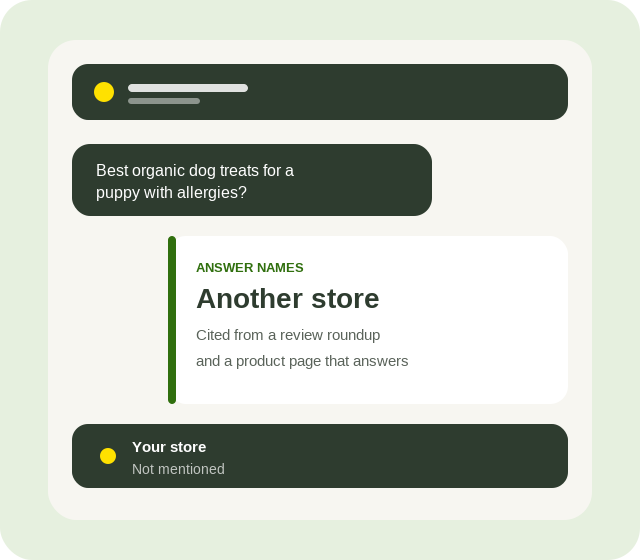
A lot of buying questions now get an answer inside the result. ChatGPT, Perplexity, Gemini and Google AI Overviews name a store, a product, or a reason to pick one over another. If your store is not in that answer, the click never starts.
AI SEO is the work of making your products easy for those systems to understand, cite and recommend. It sits on a clean Shopify store. It does not replace titles, speed, or a page that converts.
How AI search picks a store
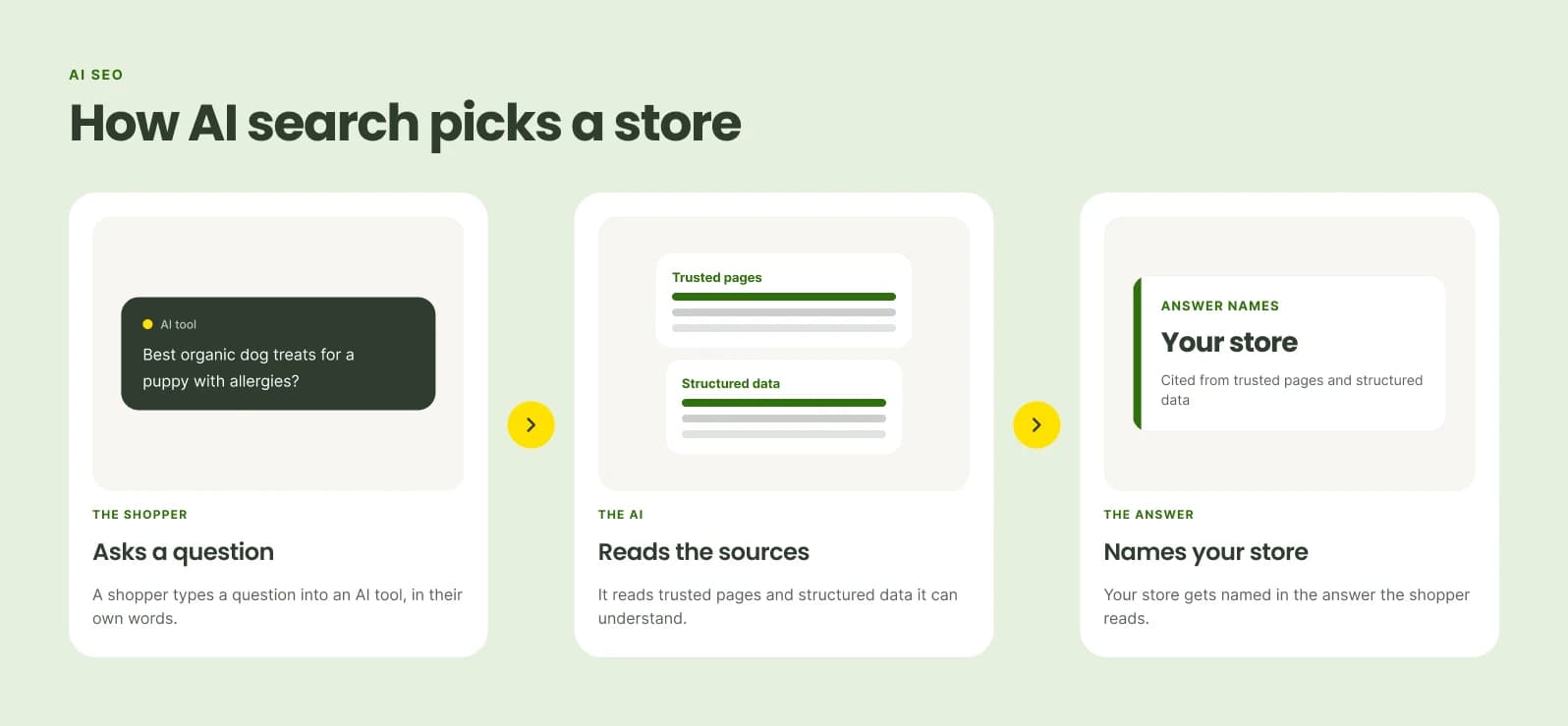
The shopper asks a question
A shopper types a question into an AI tool, in their own words.
The AI reads the sources
It reads trusted pages and structured data it can understand.
The answer names your store
Your store gets named in the answer the shopper reads.
What the public research says
Shoppers are already asking the machines.
49%
of U.S. adults have used an AI chatbot such as ChatGPT, Gemini or Copilot.
Survey of U.S. adults, Feb 17-23, 2026. Up from 33% in 2024.
Pew Research Center42%
of U.S. adults use an AI chatbot to search for information.
Same survey. Searching for information was the most common use.
Pew Research Center2 billion
people use Google AI Overviews every month.
Sundar Pichai, Google, Nov 18, 2025.
GoogleOver 10%
more Google Search use, in the US and India, on queries that show AI Overviews.
Google Search, May 20, 2025. Usage of Search, not a click-through rate.
Google
The vocabulary
Why is SEO evolving?
Shoppers used to type a short query, scan a list of links, and click. A lot of them now ask a full question and read the answer before they ever open a store.
Pew found that about half of U.S. adults have used a chatbot, and that searching for information is the most common reason. Your collection page can still rank. It can also be skipped if the answer above the links names someone else.
Google, May 20, 2025: AI Overviews are available in more than 200 countries and territories, and more than 40 languages. Source.
AIO
Artificial Intelligence Optimization
AEO
Answer Engine Optimization
GEO
Generative Engine Optimization
LLMO
Large Language Model Optimization
Four names for the same job. Get the store into the answer, not only onto the link list.
Where shoppers ask
How we help
We look at the same questions your buyers ask, on the tools they use, and we work on the pages those tools can actually cite. The list is the surfaces, not a promise that every one of them will name you.
Google AI Overviews
The answer above the links, on queries Google chooses to summarize.
ChatGPT
Shopping questions asked in chat, including ChatGPT search.
Copilot
Microsoft's assistant, often in the browser where people already research.
Gemini
Google's assistant, separate from the AI Overview inside Search.
Perplexity
Answers that cite pages. If you are not a source, you are not in the reply.
Traditional search
The blue links, collections and product pages that still have to convert.
The change in the query
Search used to end on a click. Now it keeps talking.
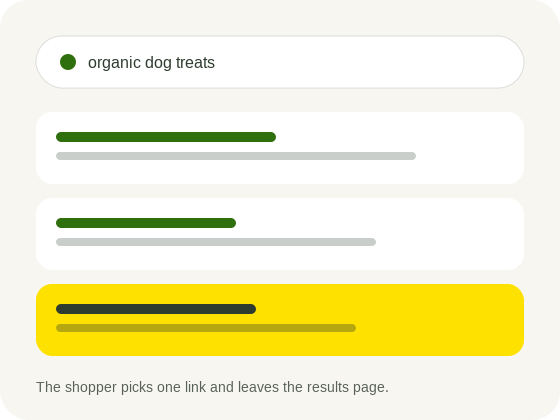
Before
Search was one search, one click.
One search. One click. One product page.
Someone typed a short product phrase and picked a link. The job was to rank for that phrase and load the page fast enough to keep them.
Now
Search is a conversation.
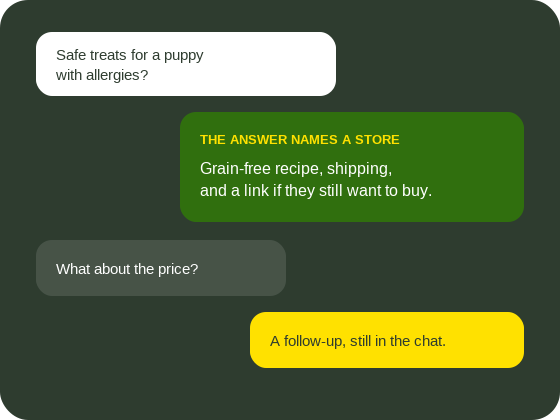
One question. Follow-ups. An answer that names a store.
Someone asks which treats are safe for a puppy with allergies, then asks about price and shipping. The answer can name a brand before any click.
The takeaway
People are shopping inside the answer. Keywords still help a page match a query. They do not, by themselves, get you named. If the answer cites another store, your ranking is a backup plan.
Side by side
Traditional SEO and AI SEO, for a store.
| Category | Traditional SEO | AI SEO |
|---|---|---|
| Search experience | A list of links for a product or category query | A written answer in Google AI Overviews, ChatGPT, Copilot, Gemini or Perplexity |
| Primary goal | Earn the click from the results page | Be the store or product the answer names |
| Shopper behavior | Scan titles, open a few product pages, compare | Read a recommendation, then click if they still need to buy |
| What you optimize | Titles, collections, internal links, speed, indexation | Clear answers, product facts, schema, and pages a model can cite |
| Content style | Keyword-aware collection and product copy | The answer first, then who it is for, ingredients, sizing, and comparisons |
| Technical | Crawlable theme, canonicals, sitemap, Core Web Vitals | Product, Organization, FAQ and Review data that matches the visible page |
| What you measure | Rankings, organic sessions, revenue from organic | Mentions in AI answers, plus referral visits from those tools |
| Buyer questions | Map keywords to collections and products | Write the question, and answer it in the first sentences |
| Trust | Reviews on the product page, links, brand searches | The same facts on your site, in Merchant Center, in reviews and in roundups |
| Content plan | One strong page per target query | Product pages, comparisons and FAQs an answer can stitch together |
| Example win | Ranking for "organic dog treats" | Being the store ChatGPT names for "best organic dog treats for a puppy with allergies" |
Together
Complementary strategies
Visibility is still the job. The path changed.
When someone asks a broad question, an AI answer often shows up first. That is where a citation introduces your store, before they have picked a product.
If the answer is useful, they click, they search your brand, or they ask a tighter question. That is where traditional SEO and a strong product page take over. The page has to match what the answer promised: the right product, a clear offer, and a checkout that works.
Stores that do both decide how they show up at the start of the question and on the page that has to close the sale.
The engagement
What's included
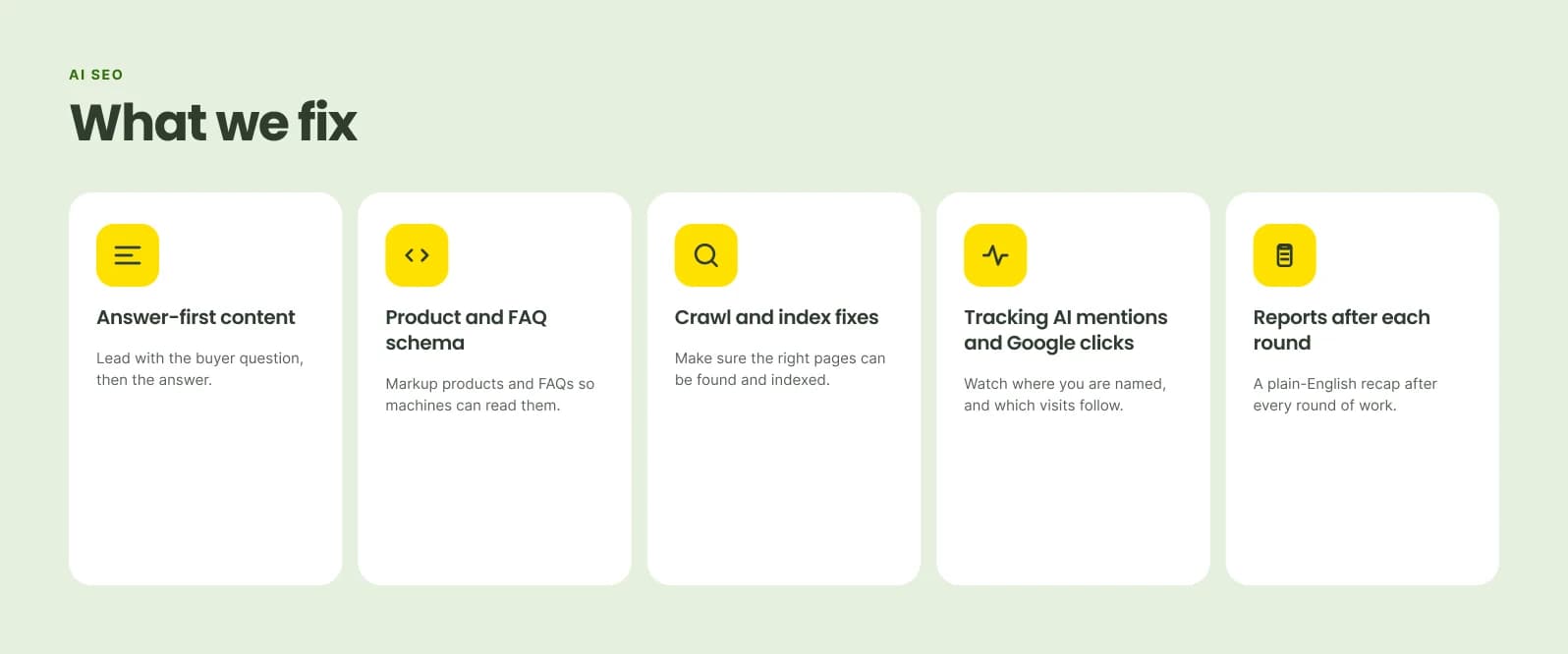
Five pieces of work. Each one is something you can see: a finding, a page, a markup check, or a report. None of them is a promise of rankings.
01
AI Visibility and Competitor Audit
We ask the buyer questions your category actually gets, across AI Overviews, ChatGPT, Gemini and Perplexity. You see who gets named, how your store is described, and where a competitor is the default recommendation.
02
Product and Collection Content Structuring
We reshape product and collection pages so the facts are easy to extract: what it is, who it is for, what is in it, how it compares. Structured data is added and checked against what a shopper can see on the page.
03
New Answer-First Content
New pages and on-page blocks that answer a buying question in the first sentence, then support it. Comparisons, FAQs and buying guides, in your voice, tied to products you actually sell.
04
CRO for AI-Referred Shoppers
People who arrive from an AI answer often land mid-decision. They already read a recommendation. We tighten the page they hit so the product, the proof and the next step match that expectation.
05
Reporting
A regular read on where you are named, where you are missing, and which AI referrals show up in analytics. You can see what changed after each round of fixes. No invented scores.
Do it yourself
How to check this on your own store
You can learn a lot before you hire anyone. These are the checks we would run on a Shopify store this week. None of them promise a mention. They show you the gap.
1.Ask the tools your buyers use
Write 8 to 12 questions a real customer would ask, including comparisons and "best for" questions. Ask them in ChatGPT, in Perplexity, and in Google, and note whether an AI Overview appears. Record who gets named, which URL is cited, and whether your store is described correctly. Run the same questions in a fresh chat so one lucky answer does not set the plan.
2.Add structured data, then validate it
On product pages, add Product JSON-LD that matches the visible title, price, availability and images. Add Organization JSON-LD for the store. Add FAQPage only for questions that are visible on that page. Add Review or AggregateRating only for reviews that are really on the page. Check the page in Google's Rich Results Test. Markup that disagrees with the page gets ignored.
3.Answer in the first sentence
For each priority question, write an FAQ or a comparison that states the answer in sentence one, then explains it. Name the product, the shopper it fits, and the constraint (allergies, size, material, budget). Do not bury the answer under a brand story.
4.Check which crawlers you are blocking
Open robots.txt. If you want these systems to read the store, do not disallow the whole site for GPTBot, OAI-SearchBot, PerplexityBot, Google-Extended or ClaudeBot. They are not the same switch. OpenAI documents OAI-SearchBot as the crawler for ChatGPT search, and GPTBot as the crawler for training. Google documents Google-Extended as a control for Gemini training and grounding. It does not control inclusion in Google Search, and it is not a ranking signal. Google Search, including AI Overviews, uses Googlebot. Leave Googlebot allowed if you want to stay in Search. An llms.txt file at your domain root is an optional plain-language summary. It is not a ranking switch. Consider one if the catalog is hard to understand from product pages alone.
5.Show up where answers get their sources
Answer engines often cite reviews, buying guides, Reddit threads and YouTube videos. Get the product facts right in the places you can honestly appear: your own reviews, a useful comparison you publish, a video that answers the question. Do not invent reviews or plant fake threads.
6.Match Google Merchant Center
The title, price, availability, identifiers and landing page in Merchant Center should match the product page. Two versions of the price, or a feed URL that 404s, give an answer engine two stories about the same product.
7.Measure the visits you can actually see
In GA4, open Traffic acquisition and look for session source chatgpt.com and perplexity.ai. In Search Console, watch the queries and landing pages for those products. Clicks from Google, including AI Overviews, are reported with your other Google Search traffic. There is no single number that means you won AI search. Keep the mention notes from step 1 next to these referrals.
Foundation, then the extra layer
Traditional SEO gets you listed. AI SEO gets you recommended.
Traditional SEO is the foundation. AI SEO is the layer on top of it. Without the foundation, the extra layer has nothing solid to cite.
Traditional SEO gets you listed
- Googlebot can crawl and index the theme
- Titles and collections match how people search
- Internal links send shoppers to the right product
- The page loads quickly on a phone
- Organic clicks and revenue are measurable in analytics
AI SEO gets you recommended
- Product facts are written so a model can quote them
- Structured data matches the visible page
- Buyer questions are answered in the first sentence
- Other credible pages mention the product accurately
- You track mentions and AI referrals, then fix the next gap
What to expect
A recent store, told straight.

Questions
Straight answers
What Shopify owners ask before they book. The short version, without a pitch.
Guarantee terms
If you're short at day 90, you get a proportional refund of the 90-day fee. Hit 80 clicks a week and you get 20% back. Clicks are measured in Google Search Console, averaged over weeks 11 to 13, compared with your starting baseline, and only count growth on top of what you already get.
Requires a live Shopify store, access to Google Search Console and your theme, and approval of changes within 5 business days.
When you are ready
See which store the answer names.
Book an AI SEO call. We will look at how the tools describe your store, and where a competitor is getting the recommendation.
100 clicks a week from Google and AI search by day 90, or you don't pay. Read the terms.
Bring your store URL. No pitch deck required to start.